
Why Replacing the Roof Felt and Covering Often Makes Sense
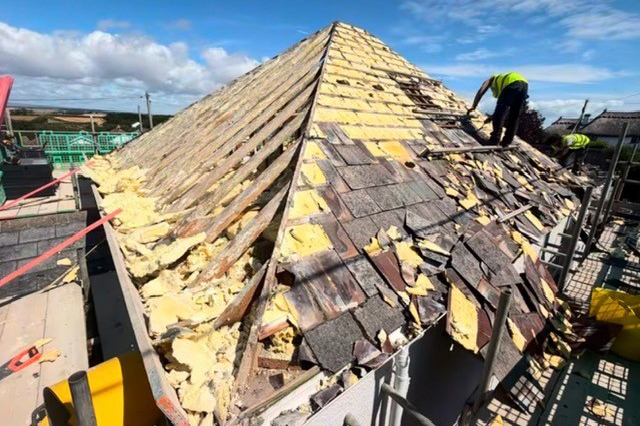
Spray foam insulation was promoted to many homeowners as a way to improve energy efficiency, reduce heat loss, and in some cases, extend the life of an older roof. Some closed-cell spray foam systems were also marketed as a way to help secure roof tiles or slates where fixings were deteriorating, the roof covering was defective, or leaks were already present.
The problem is that spray foam can change how an existing pitched roof performs. It can cover the roof structure, make inspection more difficult and, where it has been poorly designed or installed, contribute to moisture and condensation problems.
For homeowners who already have spray foam insulation in their loft, removal may therefore be only the first part of the work. Once the foam has been removed, the condition of the roof felt or underlay, battens, rafters and external roof covering needs to be properly assessed.
At Tamar Roofing & Building Services, we believe that replacing the roof felt or underlay should normally form part of a proper spray foam removal and roofing solution. On an older roof, renewing the entire roof covering at the same time can often be the most practical and cost-effective approach.
Why was spray foam used on older roofs?
Spray foam has been used in buildings for many years, and it isn't inherently unsuitable in every situation. The issue is how it is designed, installed and used within an existing roof.
RICS guidance explains that closed-cell spray foam has sometimes been used where manufacturers saw an opportunity to extend the life of roofs with defective coverings, corroded fixings or existing leaks. In other words, it wasn't always installed simply as insulation. In some cases, the foam was effectively used to hold or support an ageing roof covering and put off a more expensive roof replacement.
This is an important point for homeowners considering spray foam removal.
If the original roof was already showing signs it was nearing the end of its serviceable life, removing the foam doesn't restore it to its original condition. It can actually reveal the problems that were previously hidden.
What problems can spray foam cause?
A traditional pitched roof is normally designed around a particular combination of roof covering, underlay, ventilation and insulation. Retrofitting spray foam to the underside of the roof changes that arrangement.
RICS describes a typical loft with insulation at ceiling level as a "cold roof". Applying spray foam to the underside of the roof structure changes this towards a "warm roof", meaning the roof space and its ventilation arrangements need to be considered differently. Poorly designed or installed systems can increase the risk of moisture and condensation, while covering the roof timbers makes inspection more difficult.
The House of Commons Library has also reported concerns about incorrectly installed spray foam reducing roof ventilation, contributing to dampness or condensation and increasing the risk of timber decay. It also notes that spray foam can be difficult and costly to remove, and that its presence may affect property valuations or surveyors' ability to assess a roof's condition.
Cornwall Council's current homeowner advice similarly warns that spray foam can reduce roof-space ventilation and contribute to condensation, damp and timber decay. It also notes that covering roof timbers can make inspection more difficult during property sales or mortgage applications.
That doesn't mean every roof containing spray foam has suffered damage. It means the roof needs proper inspection, rather than assuming the foam has solved an existing roofing problem.
What happens when spray foam is removed?
Spray foam removal is a skilled and often labour-intensive process.
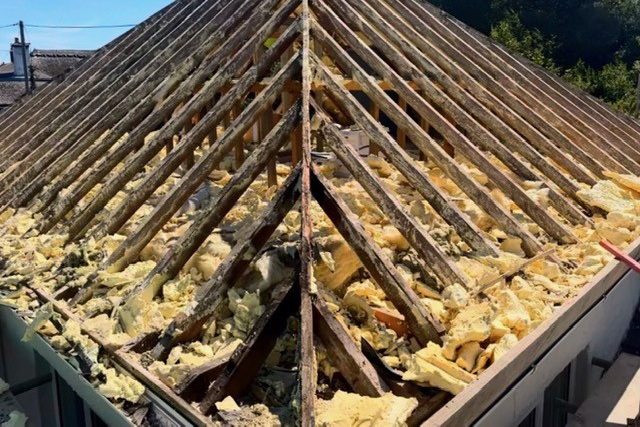
The foam may have been applied directly to the underside of the roof felt, to timber rafters, or in some installations directly to the underside of tiles or slates. Open-cell and closed-cell foams also behave differently. Closed-cell foam is rigid and can bond strongly to the surfaces underneath it, so careful removal is essential.
The removal process can expose areas of:
- Perished or damaged roof felt
- Torn or delaminated underlay
- Decayed or damp timber
- Damaged roof battens
- Cracked or broken tiles or slates
- Poor previous repairs
- Defective flashing
- Inadequate roof ventilation
- Other roofing defects that were hidden by the foam
Industry guidance on spray foam removal highlights that you can only establish the condition of the roof underneath once the foam has been removed. In some cases the existing roof can be retained, but where the underlay or other components have been damaged or are already failing, further roofing work is needed.
Why is replacing the roof felt so important?
The roof felt, more accurately referred to on many modern roofs as the roofing underlay or membrane, isn't just an optional extra underneath the tiles.
It forms a second line of defence against wind-driven rain and helps manage any water that gets beneath the external roof covering. Marley describes roof underlay as an important second line of defence for tiled and slated pitched roofs, while NHBC guidance sets out requirements for underlay installation, drainage and roof ventilation.
This is why simply removing the spray foam and putting everything back exactly as it was isn't always a sensible solution.
If the foam has been bonded to the old felt, removing it can tear or delaminate the underlay. Even where obvious damage isn't present, an older roof may already have aged, brittle or deteriorating felt that is difficult to inspect properly while the roof remains covered.
Recent guidance on spray foam removal identifies felt damage as a particular issue during closed-cell foam removal, while roofing contractors carrying out complete spray foam removal projects commonly replace the existing membrane, battens, and associated roof components as part of the work.
For that reason, we view replacing the roof felt or underlay as the minimum sensible roofing element in a spray foam removal project where the existing membrane has been damaged, deteriorated, or cannot be relied upon.
The question then becomes: how do you replace the felt properly without taking off the tiles or slates?
In most cases, you can't.
Why removing the roof covering can make sense
A typical pitched roof is built in layers. From the outside, you have the tiles or slates, followed by battens, underlay and the roof structure beneath.
If the underlay needs replacing, you usually need to lift the external roof covering so the roofing system can be rebuilt correctly.
That may initially sound like a much bigger job than simply removing the spray foam, but another factor matters: the age and condition of the roof covering itself.
Where spray foam was originally installed to extend the life of an older roof, it is worth asking whether the roof covering was already approaching the end of its useful life.
Replacing an old roof covering at the same time as the underlay can avoid paying for separate scaffolding, labour, tile removal and reinstatement at a later date.
It also gives the roofer the opportunity to inspect the roof structure properly and install a complete modern roofing system, including:
| Roof component | Why it matters |
|---|---|
Roof tiles or slates | Provides the main external weathering layer |
Roofing battens | Supports and fixes the roof covering |
Breathable or suitable roofing membrane | Provides a secondary weathering layer and helps manage moisture |
Eaves support and ventilation | Helps maintain correct airflow and drainage |
Ridge and verge system | Protects vulnerable roof edges and can improve ventilation |
Leadwork and roof junctions | Protects chimneys, valleys and other potential leak points |
Modern roofing systems should be considered as a complete roof rather than a collection of individual parts. NHBC guidance states that pitched roofs need suitable precautions against condensation and that roof ventilation depends on factors including the roof covering, underlay, insulation and roof design.
Does every roof with spray foam need a complete reroof?
No.
This is an important distinction. Spray foam removal does not automatically mean that the entire roof covering has to be replaced. In some cases, the existing tiles or slates may be in reasonable condition and can potentially be retained after the foam has been removed.
The decision should be based on what the inspection finds.
For example, retaining the existing roof covering may be reasonable where the tiles or slates remain serviceable, the roof structure is sound, and the underlay can be renewed or repaired appropriately.
A replacement roof becomes more attractive where there is a combination of:
- An ageing or failing roof covering
- Damaged or deteriorated roof felt
- Old or defective battens
- Significant foam bonded to the roof structure
- Previous leaks or poorly repaired areas
- Timber deterioration
- Damaged or slipping tiles or slates
- Poor ventilation
- A roof that was already being held together by the foam
The practical advice from roofing specialists is similar: reroofing isn't automatically required, but excessive moisture, damaged underlay, hidden roofing defects and deterioration discovered during removal are all reasons why a new roof may be appropriate.
Why a new roof can be the more economical option
Homeowners quite reasonably want to avoid unnecessary work. However, the cheapest immediate solution isn't always the cheapest solution over the life of the roof.
Imagine an older roof with spray foam insulation bonded to the underside of the existing system.
The foam is removed.
The old felt is damaged and needs replacing.
The tiles then have to be lifted so the new felt can be installed.
Some battens are found to be deteriorated.
Several tiles break during removal because of their age.
The ridge and verge details also need attention.
At that stage, a homeowner may find that much of the cost of a complete roof replacement is already being incurred.
A full reroof may then offer better value because you can renew the entire system in one operation.
It can also provide a cleaner long-term solution, particularly where the spray foam was originally installed to postpone roof replacement.
What about mortgages and selling your property?
Spray foam can also create problems that go beyond the condition of the roof itself.
It has been widely reported that some homeowners have experienced difficulties remortgaging or selling properties where spray foam insulation has been installed. One reason is that spray foam can make it harder for surveyors to inspect the roof structure properly. Lenders don't all take the same approach, so no single rule applies to every property or mortgage application.
RICS recommends that homeowners obtain independent professional advice where spray foam is present, particularly when considering its suitability, condition or removal.
If you're planning to sell or remortgage, keeping clear records of the removal work, roof repairs and replacement work can also help demonstrate what has been done to the property.
Should you remove spray foam yourself?
For most homeowners, professional removal is the safer option.
Removing cured spray foam can involve cutting, scraping and cleaning the roof structure. It can also be easy to damage the underlying felt or timber if the material is strongly bonded.
More importantly, removing the foam is only part of the job. The roof needs to be assessed afterwards to establish whether the structure, membrane, battens and external covering are still suitable for continued use.
A roofing contractor should therefore look at the complete roof, not simply remove the foam and leave the homeowner to deal with whatever is underneath.
The right approach to spray foam removal
If you have spray foam insulation in your loft, the sensible starting point isn't automatically "remove the foam" or "replace the roof".
Start by establishing:
- Why was the spray foam installed?
- What type of foam has been used?
- Was it applied to the roof felt, rafters, tiles or slates?
- How old is the existing roof covering?
- What condition are the tiles, slates, battens and roof structure in?
- What condition is the roof felt or underlay in?
- Does the roof have suitable ventilation?
- Would retaining the existing roof provide a sensible long-term solution?
Once you have those answers, you can make an informed decision.
For many older properties, removing spray foam, replacing the roof felt and renewing the roof covering as one project can make more sense than trying to preserve an ageing roof that the foam was originally used to keep going.
Spray foam removal and roof replacement in Devon and Cornwall
Tamar Roofing & Building Services works with homeowners across Plymouth, Devon and Cornwall on roof repairs, roof replacement and new roof installations.
If your property has spray foam insulation, we can assess the roof's condition and help you understand what needs to be done. In some cases, a repair may be suitable. In others, replacing the roof covering, underlay and associated roofing components as part of the spray foam removal process may be the better long-term option.
The important thing is to assess the roof in its actual condition rather than assuming the foam has protected it.
If you're concerned about spray foam insulation in your loft, arrange a professional roof inspection before committing to further work. A proper assessment can establish whether your roof needs removal and repair, partial renewal or a complete roof replacement.