
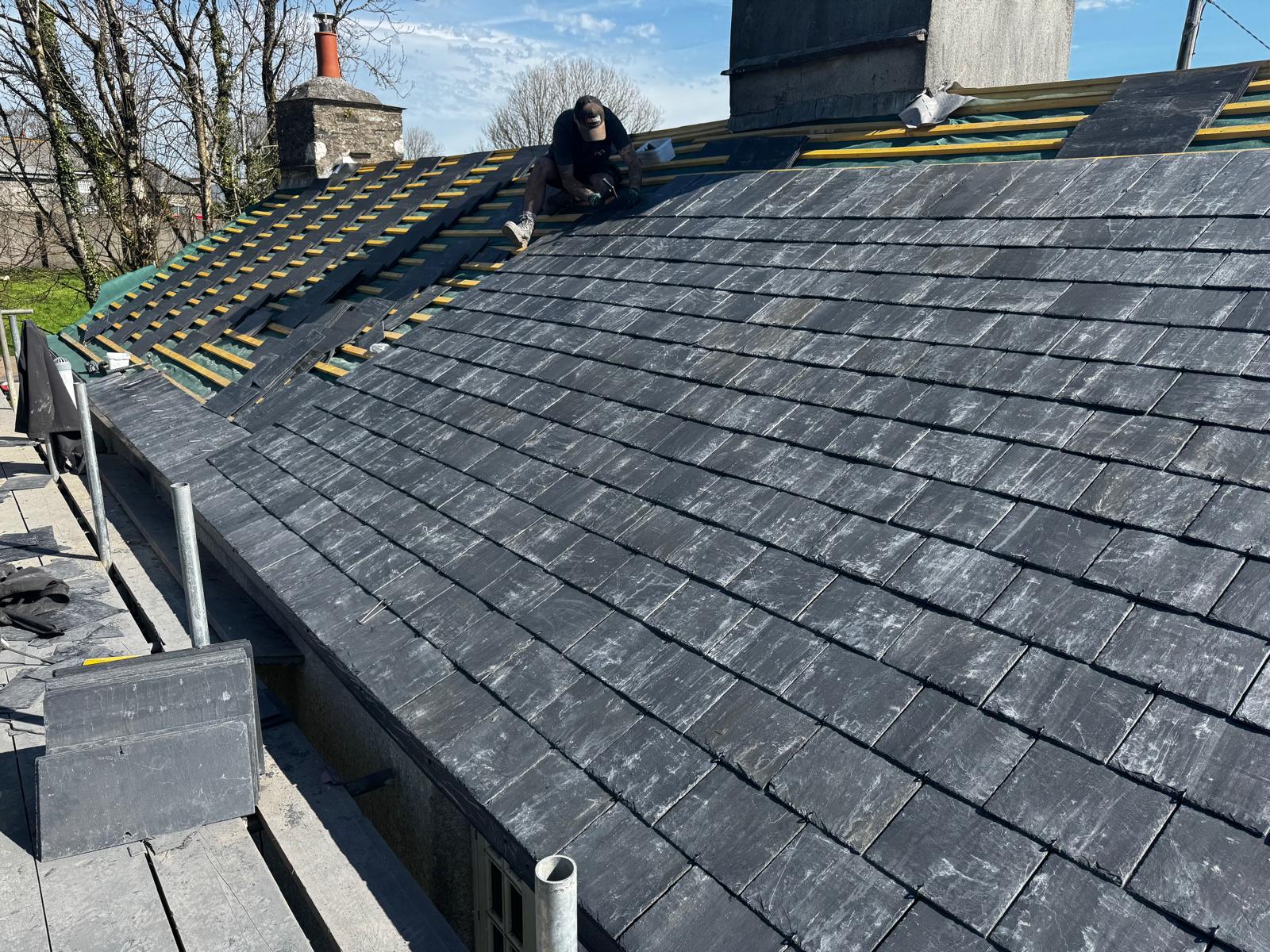
However, installing a new slate roof is very different from simply laying a set of roofing tiles. The type of slate, roof pitch, exposure to wind and rain, slate size, lap, fixings, battens, underlay, ventilation and detailing all need to work together.
At Tamar Roofing & Building Services, we carry out slate roof repairs, full re-slating and new slate roof installations across Plymouth, Devon, and Cornwall. We work with natural Delabole, Welsh and Spanish slate and have experience working on period properties, listed buildings and buildings in conservation areas.
This guide explains what homeowners should consider before replacing or installing a slate roof, including how to choose the right slate, when a full re-slate is actually necessary, and why installation details matter so much.
When does a slate roof need replacing?
One of the most important decisions is knowing whether your roof genuinely needs a complete replacement.
Natural slate is a remarkably long-lasting roofing material, and Historic England notes that slates can last longer than many other roof coverings before needing repair. Problems such as individual slipped slates, defective flashing or isolated areas of nail failure don't necessarily mean the entire roof needs to be stripped.
A professional roof inspection should therefore be the starting point.
Signs that a slate roof may need significant repair or replacement include:
- Large numbers of missing, cracked or slipping slates
- Widespread slate delamination or deterioration
- Repeated leaks across several areas of the roof
- Corroded fixings causing widespread slate movement
- Rotten or defective roof battens
- A failed or deteriorated underlay
- Defective valleys, ridges, verges, flashings or abutments
- Previous poor-quality roofing work
- Evidence that the roof covering has reached the end of its practical service life
- Roofing battens
- Underlay
- Eaves details
- Ventilation components
- Fascia and soffit areas
- Leadwork
- Valleys
- Verges
- Ridge details
- Chimney flashings
- What exact type and source of slate is included?
- Will the existing roof be inspected before the quotation is prepared?
- Are new battens and underlay included where required?
- What fixings will be used?
- How will valleys, verges, ridges, chimneys and roof abutments be detailed?
- What ventilation provisions are included?
- Will suitable existing slates be re-used?
- Does the price include scaffolding and waste removal?
- What warranty is provided?
- Does the roofer have experience with slate roofs and older properties?
- Gutters and downpipes
- Lead flashings
- Valleys
- Ridge and hip details
- Moss or vegetation
- Damp patches in the loft
- Water staining around chimneys or roof junctions
Our inspections also help identify nail sickness, failed underlay, damp in the loft and extensive moss growth, all warning signs that a slate roof needs professional attention.
Repair or complete re-slating?
It isn't always a straightforward choice.
If only a small number of slates have failed, replacing them may be the most sensible and economical option. Historic England recommends assessing whether an old roof covering is repairable before committing to a complete replacement. However, where a number of slates are failing, stripping the roof can provide an opportunity to address the underlying problems properly. Reuse of existing sound slates may also be possible.
For older or historic properties, retaining original roofing materials can be particularly important.
Choosing the right slate for a new roof
Not all natural slate is the same. Different sources have different colours, textures, thicknesses, sizes and performance characteristics.
Here at Tamar Roofing, we work with Delabole, Welsh and Spanish natural slate, selecting the material according to the property's character, the project requirements and the homeowner's budget.
Delabole slate
Delabole slate from Cornwall is world-famous for durability and can be an excellent choice where a traditional South West appearance is important.
For a replacement slate roof on a period Cornish property, the objective shouldn't simply be to choose the cheapest slate available. The new roof should complement the architecture and, where appropriate, replicate the appearance of the original covering.
Welsh slate
Welsh slate has been used extensively throughout Britain and remains a popular option for premium roofing and heritage projects. Its consistent appearance, durability and established reputation make it suitable for many residential applications.
Spanish slate
High-quality Spanish slate can offer an attractive alternative where budget and specification need to be balanced. However, quality varies between products, so homeowners should ask exactly which slate is being proposed rather than accepting a quotation that simply says "natural slate".
Why slate roof detailing matters
A slate roof isn't simply a collection of individual slates fixed to battens.
The roof needs to be designed as a complete system. Roof pitch, slate dimensions, lap, exposure, fixing method and detailing around junctions all affect how effectively the roof sheds water and resists wind.
It is important to remember that factors such as driving rain, the building's location, roof pitch and exposure need to be considered when establishing the appropriate slate lap and wind resistance. Coastal and exposed sites can present different demands from sheltered inland properties.
This is particularly relevant across Devon and Cornwall, where some properties are exposed to strong Atlantic winds and wind-driven rain.
Roof pitch and slate lap
The pitch of a roof affects how quickly rainwater runs across the slates and therefore influences the specification.
Remember that many traditional natural slate roofs commonly have relatively steep pitches and that slate lap needs to be considered alongside roof pitch and site exposure.
Getting the lap wrong can leave a roof vulnerable to wind-driven rain. This is one reason that installing a new slate roof should be treated as skilled roofing work rather than a simple covering replacement.
The importance of battens, underlay and fixings
When a roof is stripped back for a full re-slate, it's possible to inspect the roof structure and replace defective components before installing the new covering.
This can include:
This matters because old slate roofs can suffer from "nail sickness", where the original fixings deteriorate, and slates begin to slip. Historic England explains that nail sickness can sometimes be repaired locally, but widespread failure may justify stripping the roof so the problem can be properly addressed.
Ventilation is part of a modern slate roof
A new slate roof also needs to address moisture and condensation within the roof structure.
Appropriate ventilation should be designed according to the roof build-up, insulation position, membrane and other details. Ventilation requirements vary between warm- and cold-roof constructions, and suitable ventilation may be required at the eaves and ridge levels.
This isn't something that should be left until the end of the project. Ventilation needs to be considered as part of the roof design.
Slate roofing for period and heritage properties
Devon and Cornwall have a huge number of older properties where the roof contributes significantly to the building's appearance.
For historic buildings, replacing a roof with a modern material that looks noticeably different can have a much greater impact than homeowners sometimes realise.
Cornwall Council advises that the original structure, shape, pitch, cladding and ornament of a historic roof can be important parts of its character. It recommends that new slates match the existing type, colour, texture, size and thickness wherever possible, and advises re-using existing slates and ridge tiles where appropriate.
Plymouth City Council similarly points out that roofs can be a dominant feature of historic areas and advises homeowners to consider the original roof structure, shape, pitch and covering before re-covering.
That makes slate roof replacement particularly important on Victorian, Edwardian and other traditional properties throughout Plymouth, Tavistock, Exeter, Teignmouth, Ivybridge and the wider South West.
Do you need planning permission to replace a slate roof?
There isn't a single answer for every property.
For an ordinary house, replacing an existing roof covering may not necessarily require planning permission. However, additional controls can apply where a property is listed, located within a conservation area, or where the proposed work changes aspects of the building.
Historic England advises that listed buildings may require consent where changes affect the roof's shape, height, pitch, structure or type of covering. Conservation areas can also have additional planning requirements.
Cornwall Council specifically warns that changes to roof materials may be subject to listed building controls, and that external works within conservation areas may also require permission.
Before starting work on a period or listed property, check with the relevant local authority rather than assuming that a like-for-like replacement is automatically exempt. With our local knowledge and experience, we can advise on what permissions will be required.
Is natural slate a sustainable roofing material?
Longevity is one of the strongest sustainability arguments for natural slate.
Natural slate is a stone formed through geological processes, and its long service life can help reduce the frequency with which a roof needs to be replaced. Other highlights include slate's natural origin, durability, and potential sustainability benefits.
The practical point for homeowners is simple: a roof covering that lasts for many decades doesn't need to be manufactured, transported and installed again every few decades.
Slate may also be suitable for re-use. Historic England and Cornwall Council both recognise the value of retaining and re-using sound original roofing materials where practical. This is something we can advise on during the roof inspection.
How much does a new slate roof cost in Devon?
Because each property is unique, there is no definitive price for replacing a slate roof.
The cost can be affected by:
| Cost Factor | Why it Matters |
|---|---|
| Roof size | More slate, battens, labour and waste |
| Property height | Can increase scaffolding requirements |
| Roof complexity | Valleys, hips, dormers and chimneys require additional detailing |
| Slate type | Different natural slates have different material costs |
| Access | Restricted access can increase labour and equipment costs |
| Existing roof condition | Rotten battens or damaged timbers may need replacement |
| Leadwork | Chimneys, valleys and abutments can add to the project |
| Conservation requirements | Heritage properties may require specialist materials and methods |
Heritage properties may require specialist materials and methods
As a guide, typical full re-slate costs are approximately £6,000 to £10,000 for a terraced house and £10,000 to £18,000 for a detached house, although actual prices vary depending on size, slate, access, and complexity.
These figures shouldn't be treated as a quotation. A proper inspection is needed to establish what the roof actually requires. We offer free inspections and quotations without any call-out fees or charges.
How long does slate roof replacement take?
A typical residential full re-slate can take several working days, although the exact programme depends on roof size, access, complexity, weather and the amount of preparation required.
Most residential re-slates take around five to ten working days, depending on the project.
Weather can also influence roofing schedules, particularly in exposed coastal areas. Safety will always take priority over trying to maintain a fixed installation date during unsuitable conditions.
Choosing a slate roofing contractor in Devon or Cornwall
The quality of installation can be just as important as the slate itself.
When comparing quotations, ask:
For a specialist slate roof, workmanship matters. The slate, fixings and supporting roof construction all need to be specified correctly.
Maintaining a new slate roof
One of the advantages of natural slate is its long service life, but even a well-installed roof benefits from regular inspections.
We recommend inspecting pitched roof coverings twice a year and after storms or high winds, checking for loose, slipped, broken or missing slates.
Homeowners should also keep an eye on:
Small defects are usually easier and less expensive to address before they develop into major leaks or damage to the roof structure.
New slate roofs across Devon and Cornwall
Whether you're replacing the roof of a Victorian terrace in Plymouth, restoring a period property in Tavistock, re-slating a traditional home in Cornwall or installing natural slate on a new extension, the correct specification makes a major difference.
A successful slate roof replacement should combine the right natural slate with sound roof preparation, appropriate fixings, correct lap and coursing, suitable ventilation and carefully considered detailing around every vulnerable junction.
Tamar Roofing & Building Services provides slate roofing, full re-slating and slate roof repairs, with experience across Plymouth, Devon, and Cornwall. Our slate roofing service includes Delabole, Welsh and Spanish natural slate, full re-slates, slate repairs, lead flashings, ridge and hip work, and roofing work on listed buildings and conservation areas.
If you're concerned about an ageing slate roof, don't assume that a full replacement is the only answer. A professional inspection can establish whether the roof needs individual slate repairs, sectional re-slating or a complete replacement.
For homeowners considering a new slate roof in Devon, Cornwall or the wider South West, the best place to start is a detailed roof inspection and a written quotation explaining exactly what work and materials are proposed.
Planning a slate roof replacement? Tamar Roofing & Building Services offers free, no-obligation roof inspections and written quotations. Call 01752 922 752 to discuss your roof.